How to build a cybersecurity awareness program from scratch
A plain-English, step-by-step guide to standing up a security awareness program, from defining scope and picking topics to running simulations, building documentation, and measuring whether it is actually working.
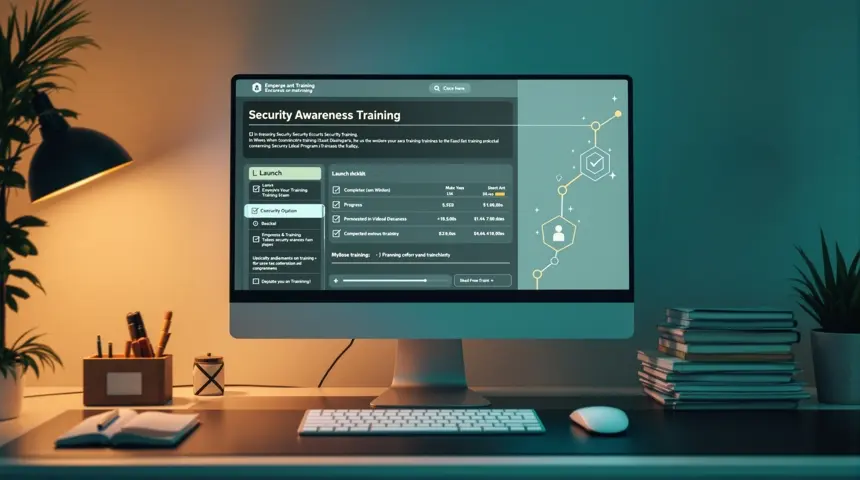
At some point, every organization reaches the same realization: someone has to teach people how to avoid getting hacked. It might come from an auditor, a cyber insurance renewal, a customer contract, or a phishing email that nearly worked. However you arrive at it, the conclusion is the same. You need a security awareness program, and right now you do not have one. The good news is that building one from scratch is not as daunting as it looks. It does not require a dedicated team, a huge budget, or months of preparation. It requires a plan, the right content, and a commitment to keep it going. Here is how to do it, step by step.
Start with why, and who is asking
Before you choose a platform or write a single slide, get clear on why this program exists. The reason matters because it shapes everything else, from scope to frequency to what you document. In practice, the motivation usually comes from one or more of a few places. A compliance requirement, such as HIPAA, PCI DSS, the FTC Safeguards Rule, or NYDFS Part 500, that names training as an obligation. A cyber insurance application that asks whether employees are trained, and increasingly wants proof. A customer or partner contract that requires evidence of a security program. Or simply the recognition that people are how most breaches start, and an untrained workforce is an open door.
Naming the driver is not academic. If you are building the program to satisfy a specific framework, you need to know what that framework expects to see, including how often training must happen and what records you must keep. If you are building it to lower risk, your emphasis shifts toward phishing simulations and behavior change. Most organizations are doing both at once, and a well-built program serves both masters. The important thing is to be honest with yourself about which drivers apply, because that determines what good looks like.
Define your audience and scope
The next step is deciding who gets trained. The short answer is everyone, but the useful answer is a little more precise. Most frameworks that mandate training use language like all personnel or all members of the workforce, which includes full-time employees, part-time staff, contractors, volunteers, and anyone else who touches your systems or data. If someone can receive a phishing email or log into a work account, they are in scope. This is not a place to save effort by excluding groups. The people you leave out are precisely the ones an attacker will find.
That said, not everyone needs the same depth. A finance employee who approves payments needs specific guidance on business email compromise and payment verification. An IT administrator needs more on credential handling and privileged access. A receptionist needs the fundamentals and a clear reporting path. Most organizations start with a single core curriculum for everyone, then layer targeted material for the roles where the risk and the stakes are highest. You do not need to build twenty different tracks on day one. Start with one solid baseline and grow from there.
Choose your core topics
A good foundational program covers the threats people actually face, in plain language. If you have read about what annual security awareness training covers, you will recognize the list, because the core topics are remarkably consistent across frameworks. They include phishing and social engineering, the single highest-impact topic in any program; password security and multi-factor authentication; safe data handling and classification; remote work and device security; incident reporting; and acceptable use. Together, these cover the human behaviors that cause the vast majority of incidents.
As you select topics, resist the urge to be exhaustive. A program that tries to cover everything covers nothing well. Focus on the handful of behaviors that matter most for your organization, and make sure each topic translates into something a person can actually do, such as pausing before an urgent request, or reporting a suspicious message. The goal is behavior change, not information transfer. If an employee finishes training and can recognize a phish and report it quickly, the program has done most of its job.
Pick your delivery and cadence
How you deliver training matters as much as what you teach. The evidence, discussed in detail in does security awareness training reduce security incidents, is clear that a single once-a-year video produces little durable behavior change. The programs that work combine short, practical content with reinforcement throughout the year. In practice, that means a brief baseline course delivered annually, supported by shorter refreshers, reminders, and realistic simulations spread across the months in between.
The mechanics are simpler than they used to be. A dedicated training platform handles enrollment, delivery, reminders, and record-keeping automatically, which removes most of the administrative burden that used to make these programs painful. If you are a small or mid-size organization, you almost certainly do not need an enterprise learning management system with hundreds of features. You need a tool that delivers the content, tracks completion, and produces documentation on demand. For guidance on choosing without overbuying, see this practical guide for small businesses.
Set up phishing simulations
Formal training teaches, but phishing simulations test whether it stuck. The two are complements, not substitutes, as explained in phishing simulations and awareness training. Once your baseline training is in place, add a few realistic, harmless simulated phishing messages throughout the year. These give you a real measurement of how susceptible your workforce is, and they reinforce the lessons from training in a way a slide deck cannot.
Two cautions apply here. First, frame simulations as a measurement and teaching tool, not a gotcha. The goal is to find gaps and close them, not to shame people. When someone clicks a simulated phish, the right response is immediate, friendly feedback that explains what the tell-tale signs were. Second, track the full picture, not just clicks. The employees who report a simulated phish are as valuable as the ones who simply did not click, because reporting gives you early warning of real attacks. Celebrate both behaviors.
Build a reporting culture from day one
The single most valuable outcome of a good awareness program is not a low click rate, it is a workforce that reports. An employee who flags a suspicious email, a strange request, or a possible mistake gives the organization early warning, often before an attack can do damage. But reporting only happens if people know how to do it, trust that they will not be blamed, and see that their reports are welcomed. This is a culture problem as much as a process problem.
Make the reporting path simple and visible. Tell employees exactly who to contact, through what channel, and what to include. Remove any fear of looking foolish by repeatedly reinforcing that a false alarm is always better than silence. When someone reports, thank them, even if it turns out to be nothing. Over time, this turns the workforce into a human sensor network, which is one of the strongest defenses an organization can have. The organizations that run security champions programs, described in security champions, take this idea further by embedding engaged employees across teams.
Document everything from the start
Here is a hard truth that trips up a lot of first-time programs: a training session that is not documented is, for practical purposes, a training session that did not happen. Auditors, regulators, and insurers evaluate what you can prove, not what you claim. If you cannot produce a roster of who completed training, with dates and topics, your program provides little protection when someone asks for evidence. This is why documentation is not a finishing touch, it is part of the program itself.
Build documentation in from the beginning. Keep completion records with names and dates. Issue certificates with unique identifiers. Maintain a summary of the curriculum and the topics covered. Store it all somewhere you can access in minutes, not days. A platform that generates audit-ready reports automatically turns this from a chore into a side effect of running the program. When the insurance renewal arrives, as discussed in what carriers ask for at renewal, you will be glad the records are already in order.
Measure what actually matters
Once the program is running, you need a way to know whether it is working. Completion rate is the obvious first metric, and it matters for compliance, but it only tells you that people finished, not that they learned anything. The more meaningful measures, explored in how security awareness metrics matured, are behavioral. Track your phishing simulation click rate over time, and watch whether it falls. Track your reporting rate, and watch whether it rises. Together, these tell you whether the program is actually changing behavior, which is the whole point.
The goal is a feedback loop, not a scoreboard. When a simulation reveals that employees are clicking on a particular kind of lure, that is a signal to update your training content. When reports spike about a specific email, that is a prompt to investigate whether a real campaign is underway. The organizations that get the most from awareness programs treat measurement as an input to improvement, not a report card to file away.
Get leadership on board, and build champions
A security awareness program that lives only inside the security or IT team has a shelf life. Real programs have visible leadership support, because that support is what gives the program legitimacy and keeps people engaged. This does not require dramatic gestures. It requires a leader who mentions the program, participates in it, and reinforces that security is everyone's responsibility, not a chore imposed from above. When leadership treats training as important, the rest of the organization follows.
Beyond leadership, identify a few employees who are naturally interested in security or trusted by their teams, and empower them as informal advocates. These security champions answer questions, reinforce good habits, and surface concerns before they become incidents. You do not need a formal program or a big budget to start. A handful of willing people, given real support and a direct line to the security team, can multiply the reach of your program far beyond what a single person could do alone.
Avoid the mistakes that sink programs
Most first-time awareness programs fail for a small number of predictable reasons, and knowing them in advance is half the battle. The most common is treating training as a one-time event rather than a recurring program, which produces a certificate but no behavior change. Another is skipping documentation, which leaves you unable to prove the program existed when someone asks. A third is overbuying, spending on an enterprise platform when a simpler tool would do. A fourth is making simulations punitive, which breeds resentment instead of learning.
There is also a subtler failure mode: building the program without knowing why it exists. When the motivation is unclear, the scope drifts, the content gets generic, and the program becomes a box to check rather than a defense. The organizations that succeed are the ones that can articulate, in one sentence, what the program is for, who it protects, and how they will know it is working. Everything else follows from that clarity.
A simple plan to launch
You do not need to boil the ocean to get started. A practical launch plan looks like this. First, identify your drivers, whether compliance, insurance, a contract, or risk, and write down what they require. Second, define your scope, confirming that every employee, contractor, and anyone else with system access is included. Third, select a core curriculum covering phishing, passwords, data handling, and reporting. Fourth, choose a platform that delivers the content and documents completion automatically. Fifth, enroll everyone and run the baseline training. Sixth, schedule a few phishing simulations and refreshers across the coming year. Seventh, establish your documentation and your reporting path from the outset. None of this is technically difficult, and with a focused platform, the setup takes a matter of hours, not months.
What turns that launch into a durable program is consistency. Keep the content current, keep the records clean, keep reinforcing the habits, and keep measuring. The organizations that treat security awareness as a standing discipline rather than a one-time project are the ones whose people actually get harder to trick over time. Simple Training Center helps organizations do exactly this, delivering practical employee training, tracking completion, and maintaining audit-ready records from a single platform, so building a program from scratch is a manageable step rather than a mountain.
Frequently asked questions
How long does it take to build a security awareness program?
With a focused training platform, the initial setup typically takes a matter of hours, not months. Defining scope, selecting content, enrolling employees, and launching a baseline course can be done in a day or two. What takes longer is building the ongoing reinforcement, simulations, and documentation that make the program durable, which is an ongoing discipline rather than a one-time project.
What should a security awareness program cover at minimum?
At minimum, a foundational program should cover phishing and social engineering, password security and multi-factor authentication, safe data handling, remote work and device security, incident reporting, and acceptable use. These are the topics that map to the human behaviors behind most security incidents, and they are the ones most frameworks expect to see in an annual program.
Do I need phishing simulations, or is training enough?
You need both. Training provides the knowledge, and simulations test whether it stuck. Training without testing leaves you guessing whether people actually learned anything, and testing without training is unfair, since you are measuring a skill you never taught. Together they create a feedback loop that measurably improves the human layer over time.
How much does a security awareness program cost?
For most small and mid-size organizations, a solid program costs between roughly thirty and sixty dollars per employee per year. Enterprise platforms can cost far more, but small teams rarely need those features. The key is to avoid free options that lack documentation, because a program you cannot prove happened provides little compliance or insurance value.
What documentation do I need to keep?
Keep completion records with names and dates, certificates with unique identifiers, a summary of the curriculum and topics covered, and evidence that the training is current and recurring. This is what auditors, regulators, and insurance underwriters ask for, and the ability to produce it quickly is what turns training from a claim into a defensible control.

Related reading
All articles

Written by
The Simple Training Center Team
We build and run Simple Training Center. These articles come from our work making compliance and security training practical for small and mid-size teams. No guest posts, no fluff.
More from the teamPut it into practice
Reading is step one. Training is what keeps you compliant.
Turn these insights into action. Our role-based security training takes minutes to set up and gives every learner a verifiable certificate of completion.