SOC 2 Security Awareness Training Requirements: What Auditors Expect
Does SOC 2 require security awareness training? Learn what SOC 2 auditors expect, what your training must cover, and how to document it.
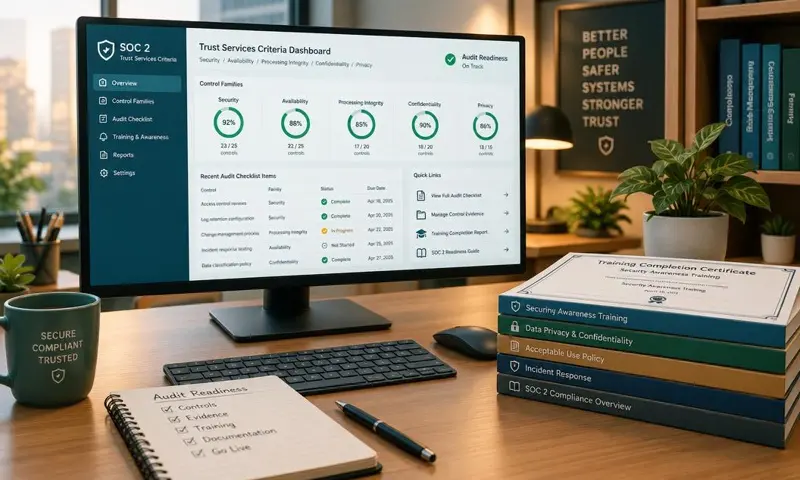
Here is the short answer: SOC 2 does not name a single "security awareness training" control you can tick and move on from, but auditors will still expect a documented training program every time. The AICPA's Trust Services Criteria require evidence that your people understand the security policies they are expected to follow, and the practical, accepted way to demonstrate that is with ongoing, tracked awareness training. In this guide we cover where training sits in the criteria, what auditors actually ask for, how often to run it, and how to prove it when the audit arrives.
Where security awareness training fits in SOC 2
SOC 2 is built on the AICPA's Trust Services Criteria. The Security criteria, known as the Common Criteria (CC), are mandatory for every SOC 2 report; the others (Availability, Confidentiality, Processing Integrity, and Privacy) are optional. Training is not one isolated control, it is woven through the organizational context and people-focused criteria, which care less about firewalls and more about whether your workforce is informed, competent, and accountable.
The CC control families
The Common Criteria are grouped into nine families, from CC1 (Control Environment) through CC9 (Risk Mitigation). Training is most directly tied to CC1, which covers a commitment to integrity, ethical values, and competence, and to CC2, which covers how the organization communicates expectations. But its fingerprints appear throughout the report: the SOC 2 requirements around monitoring (CC4), logical access (CC6), operations (CC7), and risk mitigation (CC9) all quietly assume a workforce that knows the rules and can be held to them.
CC 2.2 and the "people" criteria
CC 2.2 is the point most auditors circle. It requires that the entity communicate information so personnel can understand and carry out their internal control responsibilities. In plain terms: it is not enough to have a security policy sitting in a shared drive. Your people have to actually know it, understand it, and be able to follow it. That single criterion is what turns a written policy into a training obligation, because training, plus a record of it, is the only credible evidence that people understand their responsibilities.
What SOC 2 auditors actually look for
A written policy
Everything starts with a documented information security policy that states employees are required to complete awareness training, and how often. The policy sets the expectation; the training is the proof that the expectation is real and enforced.
A program that runs on a regular cadence
A one-time onboarding session is not a program. Auditors look for training that recurs at a defined interval and reaches both new hires and existing staff. A program that happens once and is never revisited reads as a paper exercise rather than a living control.
Role-based content
Not everyone faces the same risks. Finance teams deal with wire fraud and business email compromise, engineers handle credentials and production systems, and executives are prime targets for impersonation. Auditors respond well to training that reflects these differences, including focused modules such as phishing and social engineering training for the staff most exposed to email and payment fraud. If you are weighing providers, our guide to choosing online cybersecurity training covers what auditors expect a program to actually include.
Documented completion records
This is where most organizations fall down. The training may well have happened, but there is no record of it. Auditors want to see who was trained (ideally by name), when, on what content, and that completion is tracked and followed up when someone is overdue. Certificates and completion reports are what turn a good intention into evidence.
How often should SOC 2 security awareness training be delivered?
There is no single sentence in SOC 2 that dictates a cadence, which is why auditors fall back on established practice. That practice, and what you should expect to be asked for, is training at least annually for all employees, plus immediate training at onboarding for new hires, and targeted refreshers whenever a significant threat, incident, or policy change occurs. Many organizations now run annual training alongside shorter interim touch points, such as quarterly phishing simulations or micro-modules, because ongoing reinforcement produces both better behavior and stronger documentation than one large yearly event.
Who needs SOC 2 security awareness training?
Effectively everyone who touches your systems, data, or customers: full-time employees, contractors, and anyone with access to production or sensitive information. That includes leadership. Auditors often pay particular attention to whether executives and managers are included, because a program that quietly exempts leadership looks top-down on paper only. If a person can cause or prevent a security problem, they belong in the program.
How to prove it at audit time
When the auditor asks for evidence, you should be able to hand over four things: the policy requiring training, the training content or syllabus, a completion certificate or record for each individual, and a report showing completion rates and follow-up. This is where a documented, centralized approach pays off enormously. Simple Training Center delivers self-service, audit-ready security awareness training with per-employee certificates and completion tracking, so you can produce that evidence on demand, without a sales call. You can review pricing and subscribe online in minutes, or explore the SOC 2 training course to get your team started today.
Frequently asked questions
Does SOC 2 require security awareness training?
SOC 2 does not name a specific course, but the Trust Services Criteria require you to communicate security expectations to personnel and show they can carry out their responsibilities. In practice, auditors expect a documented, recurring awareness training program as the evidence that satisfies that requirement.
What does SOC 2 require for security awareness training?
Most auditors look for four things: a written policy that requires training, a program delivered on a regular cadence, content that reflects the risks each role faces, and documented completion records for every employee.
How often should employees complete SOC 2 security awareness training?
Annual training is the baseline most auditors expect, plus onboarding training for new hires and refreshers after incidents or policy changes. Many organizations add quarterly phishing simulations or short interim modules for ongoing reinforcement.
How do you document SOC 2 training for an audit?
Keep the training policy, the course content, individual completion certificates, and a report showing completion rates and follow-up. Producing these quickly and consistently is what turns training into audit evidence.

Go Beyond Generic AML/BSA Training
Your AML training should reflect your business—not a generic checklist. Soflo Consulting develops customized, risk-based AML/BSA training tailored to your organization’s operations, regulatory obligations, and real-world financial crime risks.
- Training tailored to your AML program and operational risks
- Short, practical video modules with real-world scenarios
- Employee assessments and verifiable certificates
- Documented training records to support examination readiness
Compliance guides
Stay Ahead of Compliance
Get regulatory updates, new course alerts, and practical compliance guidance delivered to your inbox — no fluff.
No spam. Unsubscribe any time.
Related reading
All articles
Written by
The Simple Training Center Team
We build and run Simple Training Center. These articles come from our work making compliance and security training practical for small and mid-size teams. No guest posts, no fluff.
More from the teamPut it into practice
Reading is step one. Training is what keeps you compliant.
Turn these insights into action. Our role-based security training takes minutes to set up and gives every learner a verifiable certificate of completion.